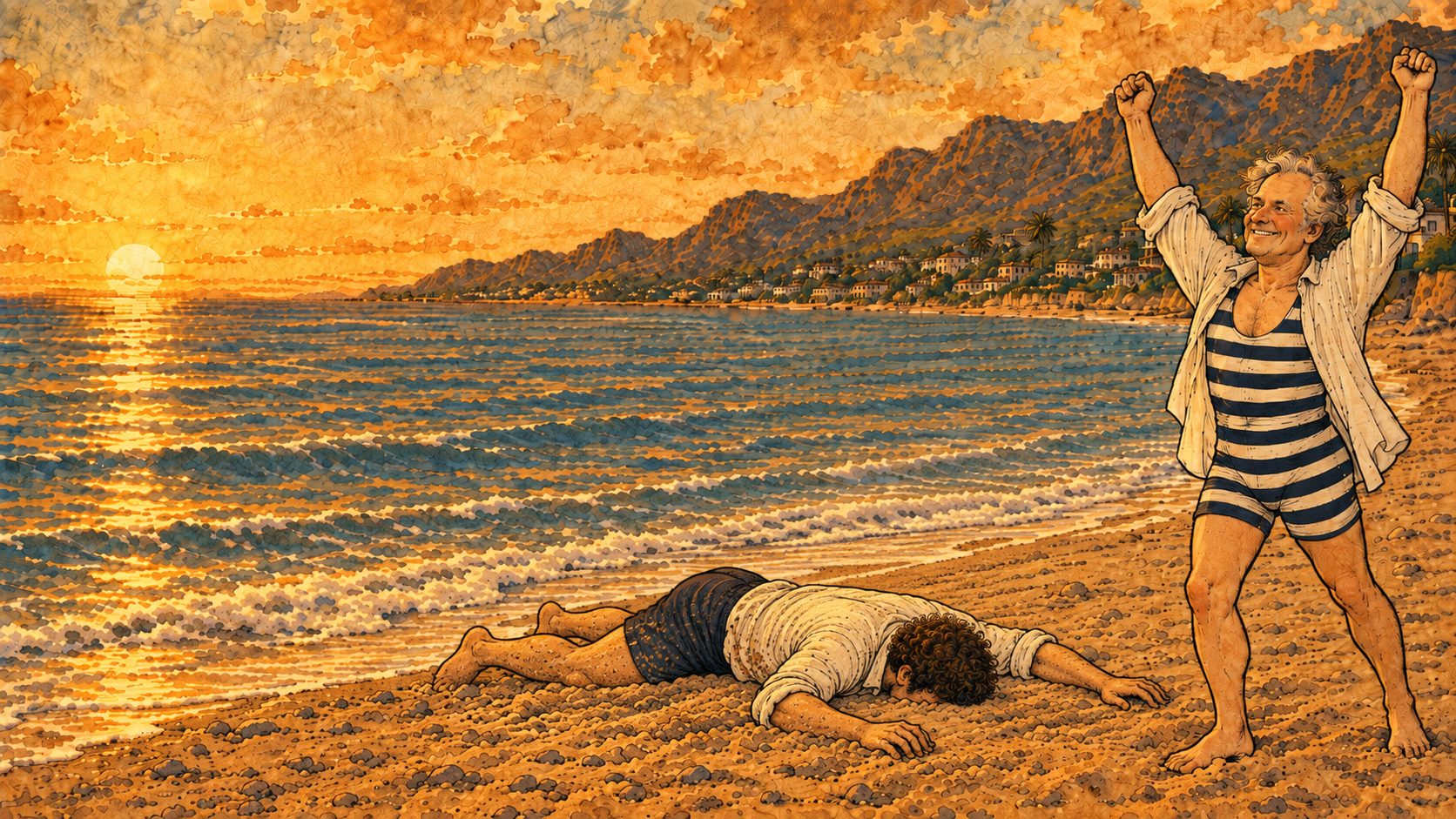
I set out to write an economic geography paper in six days from a beach, with AI tools and no human collaborators, streaming every hour. I did not finish it.
My plan was to write an entire paper from an island in the South China Sea, but on my first night of streaming I realized the connection was going to be too weak to keep a stream running, so I relocated to my office at the University of Hong Kong on Hong Kong Island (technically an island in the South China Sea, but not the one I had in mind!).
The new location solved the connectivity problem, but it also came with distractions that made it harder to stay focused on the paper. Over the week I completed most of the analysis for a paper on rural innovation in the United States. The paper builds on Castaldi, Cortinovis and Tessarin (2026) in Economic Geography and aims to go further by identifying the specific role rural innovation plays within the wider innovation ecosystem.
Judged on its own terms, the experiment was a failure, since I did not produce a finished paper in the time I set myself. As I committed at the outset, I will do 24 hours of service to make up for it, and I will complete them by January 2027. If you have something I can help with, please write to me at adler@hku.hk.
I will also finish the paper over the fall so that the archive contains a complete paper rather than a partial one. At some point I will try the experiment again from an island, once I am confident the internet there can support it.
The full streams from the week are on YouTube.
I went into this with the intuition that if large audiences are willing to watch people play video games, academics might be willing to watch other academics write papers. Looking back, that was a millennial academic conceit, and it was wrong. I now suspect that there is a large entertainment gap between the action of a speedrun and the reality of writing a paper, which mostly involves reading, thinking, and typing. During the week I tried to make the stream more engaging by using Claude to code live trackers of my AI use, but even my most supportive viewers told me that the result still wasn’t a satisfying thing to watch.
Editing matters a lot in traditional linear media, and perhaps it could pay off in this case. Edited versions of the week, one about a minute long and another about ten minutes, could show other researchers what AI-assisted research can actually do (the highlights) while sparing them the second-to-second minutiae. The supercut could also give people outside academia a way to see how research gets done and to connect with the people doing it. I will prepare a digest like this once I have finished the paper.
Hong Kong has some of the fastest and most widely available internet anywhere, and I still couldn’t keep a stream running from a beach a short ferry ride from the city. The experiment was built to test whether AI could free research from place, and the first thing it ran into was a very ordinary form of place: where the signal is strong and where it isn’t. Before any question about tacit knowledge or co-presence came up, the friction of distance showed up as infrastructure.
The conversations were supposed to be a way to let off steam after long writing days, but they ended up being much more. As I read them, the Progress in Human Geography editorial statement and the views Noel Castree and Mark Carrigan shared in Conversation Three reflect what I would call an authorship model, in which human achievement is the core value in research and AI’s role should be judged against that standard. Others, including me and my guests in Conversation Two, Peter Matanle and Parth Goyal, who works outside academia, lean toward a mission model, in which scholarship exists to advance intellectual and practical agendas, and in which it is possible in principle for that to happen through copiloted or even AI-led work. I now plan to do more of these conversations, in the hope of helping to bridge the gap between people who want academia governed like competitive chess and people who would accept something more radical.
Going forward, I plan to record the AI-assisted work on all of my projects. I see no good reason not to preserve the prompts and video from doing research with AI. Kept systematically, that record could support evidence-based ways of determining authorship, rather than relying on the honor system as we do now, and it could help the field learn what good practice actually looks like.
Streaming the work kept me accountable and focused in ways that working alone usually doesn’t. That may be specific to me, and your mileage may vary.
Patrick Adler · Department of Geography, University of Hong Kong
30 September 2026